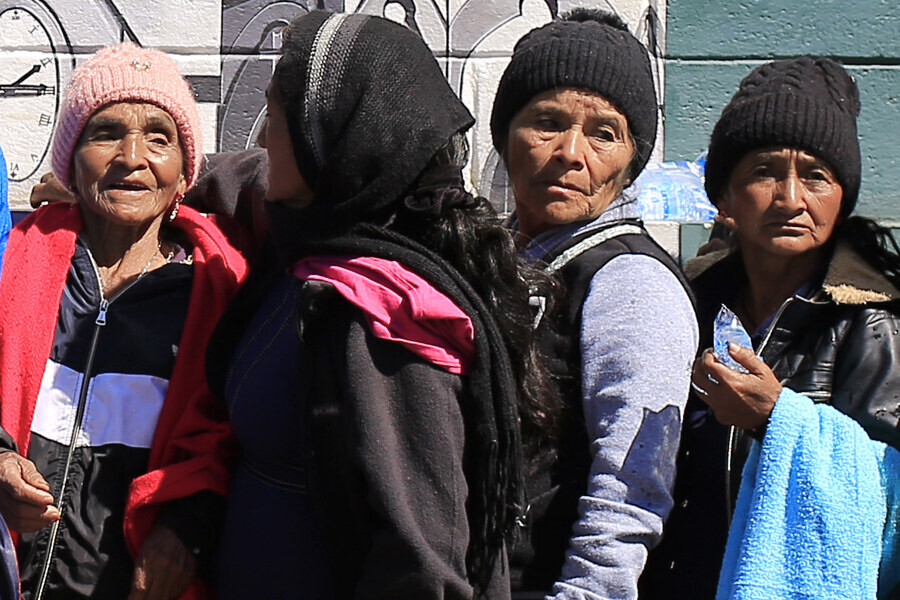
Central America faces an extraordinary cold wave this Monday, hitting mainly Guatemala, Honduras, and El Salvador, with historic temperatures as low as -2 degrees in some mountainous areas, with the exception of Panama.The low temperatures that the region has been experiencing since the weekend have occurred during an extreme cold wave affecting several U.S. states, although Central American meteorological authorities do not directly associate both phenomena.Guatemala is the country with the most significant temperature drop, registering -2 degrees in the mountainous area of Los Altos—the coldest in the country—in the west, while in other areas closer to the Pacific coast, temperatures are around 22 degrees."These temperatures are due to the high-pressure system affecting us, a cold air mass that has settled in the country," explained Cleofas Culajay, spokesperson for the National Institute of Seismology, Volcanology, Meteorology, and Hydrology of that country in a video shared on social networks.In El Salvador, temperatures dropped during the early morning to 3.5 degrees in the coffee area of Los Andes farm in Santa Ana, in the west of the country, an unprecedented figure, as the lowest previously recorded was in 1988, at 4 degrees, according to the Ministry of Environment.The rest of the country will maintain an average temperature of 22 degrees in the afternoon and 15 degrees at night, according to authorities.Honduras will continue under the influence of a "cold air mass over the national territory, which produces cloudy conditions, a drop in temperatures, rain, and weak to moderate scattered showers" in almost the entire country, especially affecting the north and mountainous areas, warned the Secretariat of Risk Management and Contingencies.Forecasts predict minimum temperatures of 2 degrees and maximums of 11 in the municipality of Intibucá, in southwestern Honduras, while in the rest of the country, temperatures will range from 5 degrees in elevated areas to 32 degrees in the hottest areas near the Pacific.Thus, Nicaragua also forecasts around 16 degrees in the central department of Jinotega, as well as around 18 degrees in the north of the country and between 21 to 24 degrees in the rest of the municipalities, temperatures that are due to "the approach of a cold front," according to Manuel Prado, head of the Climate Change Directorate of the Nicaraguan Institute of Territorial Studies (INETER).Photograph of women wearing hats during a cold spell this Monday, in Tegucigalpa (Honduras).Costa Rican authorities indicate that the cold air mass will "favor" "cool" temperatures in much of the country.Strong windsHowever, from Guatemala to Panama, warnings remain in effect for strong wind cycles of about 40 kilometers per hour, with possible roof detachments, falling trees, or damage to power lines, so authorities are exercising caution.In Costa Rica, a meteorological report warns of gusts of up to 110 km/h in the lower areas of the mountains of Guanacaste province, in the northwest of the country, which could cause landslides and heavy surf.In Panama, authorities alert to "windy conditions over the country, with intensified north winds with speeds between 20 and 35 km/h and gusts over 40 km/h," mainly in the Central, Metropolitan, and Western Pacific regions.In Guatemala, strong north winds (35-45 km/h) are forecast, with gusts that could cause metal sheet, tree, and billboard detachments, and damage to power lines; and in El Salvador, authorities indicated that "north winds" could vary between 10 and 25 km/h, with occasional gusts between 40 and 70 km/h.Photo EFE