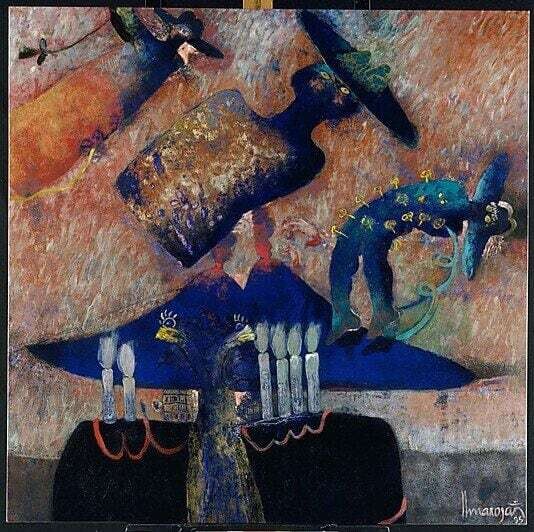
In the pictorial imagination of Elmar Rojas (1942-2018), “the scarecrow” is a recurring figure that the Guatemalan artist uses in his painting as an emblematic guardian of the rural memory of our peoples. However, for Rojas, this character ceases to be the ancestral figure and traditional allegorical object we know in our crop fields, to become a magical spiritual presence, suspended between the earth and the sky, between the visible and the invisible. Without a defined corporeal form, his iconic scarecrows always wear wide-brimmed hats, and also perform strange activities that border on the terrestrial and the supernatural, adopting a variety of poses, forms, and colors. At the same time, their flexible bodies and the ghostly condition of their existence remind us of the imperishable characters of Central American mythology, as well as those mysterious entities that still endure in the collective imagination of our peoples, such as La Llorona, Silván, and many others. The ethereal composition, veils of color, and oneiric atmosphere constitute an essential part of the unmistakable language of the great Latin American master. His visual poetics dialogues with the profound identity of our territory, with the common denominator being the magical realism that historically identifies the art and literature of the Latin American region, just as it happens with music. His paintings are always characterized by a touch of mystery represented in those suspended bodies—as if levitating—and intense colors in contrast with overwhelming dark and somber areas, which seem to evoke at once both sublime spirituality and the hardened fighting spirit resulting from the constant vicissitudes that our people have faced throughout history. For Latin America, the name Elmar Rojas evokes not only a recognized painter of international prestige, but a builder of dreams, who managed to capture on canvas the identity and transcendence of our Latin American territory for posterity. Elmar Rojas died in Guatemala on February 18, 2018, at the age of 75, leaving behind an invaluable artistic legacy. His work incorporates various enigmatic characters in scenarios that seem to emerge from dreams. This painter was a true visionary who explored the legends and magical universes of our ancestors with the mastery of a consecrated artist, thereby deserving international recognition. In his work, Elmar Rojas used a unique technique and an unmistakable personal style that very few painters have been able to imitate. His visual narrative connects the ancestral with the contemporary, managing to transform the everyday into the extraordinary. The superposition of layers of paint and subsequent scraping produces a chiaroscuro effect with subtle nuances of tonalities and deep diffused shadows that dramatize and fill the scene with mystery, which is especially effective to give a magical atmosphere to his scarecrows, which in consequence seem to emerge from the depth of each of the rich iridescent and luminous colors: blues, violets, yellows, reds, and oranges, that characterize his work. His training as an architect probably allowed him to combine the discipline and rigor of technique with the freedom and expressiveness of painting; a duality that marked his style throughout his life, turning his legacy into a bridge between tradition, collective memory, and modernity. By the way, a good example of the latter is the recent and extraordinary Bad Bunny concert at the Super Bowl. Elmar Rojas was a pioneer in painting through the cosmovision of his country, loaded with symbols, and the mysticism of the nahuals or shamans of his native country.